

Complete Rules
version 1
 Click here for a quick reference guide to these rules
 Click here for a printable PDF version of these rules
Table of Contents
- What You Need To Play
- Gameplay Overview
- Building a Winning Hand
- Sample Mahjong Hands
- Using Special Suit Tiles
- Using Special Action Tiles
- Shuffle and Deal
- Round Start
- Taking a Turn
- Round End
- Scoring
- Payouts to the Winner
- Mistakes Happen
- Other Player Counts
- Flextra House Rules
- Contact
What You Need To Play
All you need to play Flex Mahjong is a set of Mahjong tiles and a group of friends. These rules explain the standard four player game, then give simple modifications for other player counts.
Mahjong Tiles
You can use any set of tiles as long as you have at least the tiles numbered 1 to 9 in three suits: Dots, Cracks and Bams plus the three “dragon” tiles. You need 4 identical copies of each tile. Along with these tiles, you can add any special tiles you want: Flowers, Winds, Jokers, or Blanks. This flexibility means you can play Flex Mahjong with whatever Mahjong set you have!
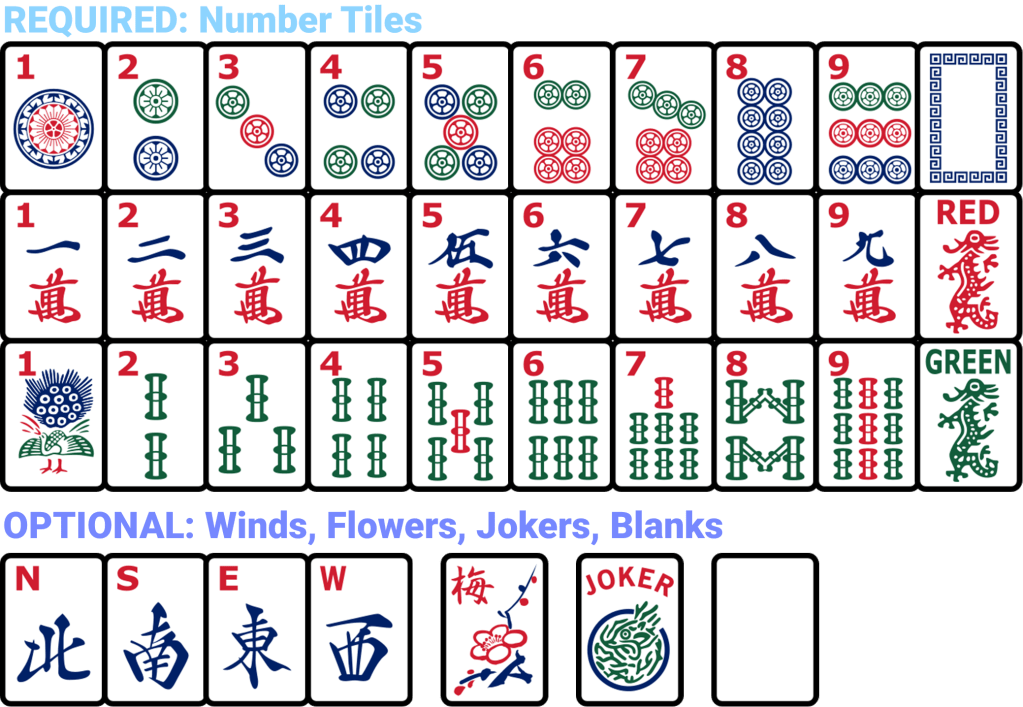
Click here for more about the tiles!
No Card Needed
Unlike other forms of American Mah Jongg, Flex Mahjong does not use a card or book of winning hands. Once you learn the Three S Rules of a winning Mahjong hand, you are ready to play!
Optional Gear
If your Mahjong tiles are big enough to stand up on their own, they can be used without racks. If your tiles are the standard American Mah Jongg size that are too small to stand up on their own, you need racks. Your Mahjong set may come with dice or a “wind indicator”, but they are not used in Flex Mahjong. You don’t have to keep score if you are just playing for fun. If you are keeping score, you can use scoring tokens like poker chips, or use coins for payouts to winners.
Gameplay Overview
The basics of American Flex Mahjong gameplay are simple. During each round, players take turns drawing a tile then discarding a tile, gradually creating combinations of tiles in their hands. Once someone builds a winning Mahjong hand by collecting tiles into matching sets that follow a few simple rules, that player wins the round and earns points based on the strength of their hand.
Building a Winning Hand
Three S’s — Suits, Sets, Sequence
When you take a tile to start your turn, you will have 14 tiles in your hand. If those 14 tiles meet the Three S Rules — Suits, Sets, Sequence — then you have a winning Mahjong hand!
Suits:
- Use no more than two suits in your hand.
- The suits are: Bams, Cracks, Dots, Winds, & Flowers.
Your hand can use tiles of only one suit, or two suits, but not more than that. You can use any pairing of the 5 suits, or use a single suit.
Example Valid Suits




Example Invalid Suits



Sets:
- All tiles must be grouped into sets of 2 to 4 identical tiles.
- Identical tiles must be of the same suit and number.
- Each number can only be used in one set per hand.
If you’ve played any Rummy card games, this rule will be familiar to you. All the tiles in your hand must be combined into sets, which are groups of 2, 3, or 4 identical matching tiles of the same suit and same number. There are names for the sets based on the number of tiles in the set:
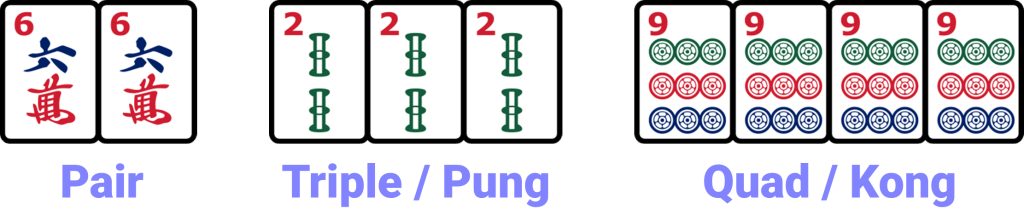
Sequence:
The numbers used in sets must be in consecutive order from one of these sequences:
- Runs: 0, 1, 2, 3, 4, 5, 6, 7, 8, 9, 10
- Evens: 0, 2, 4, 6, 8, 10
- Odds: 1, 3, 5, 7, 9
- Threes: 0, 3, 6, 9
Players of Standard American Mah Jongg will recognize the sequences as the categories found on popular Mah Jongg cards. In Flex Mahjong, you have to build sets that use numbers that are in consecutive numerical order from one of the number sequences.
Examples Valid Sequences




Examples Invalid Sequences




Sample Mahjong Hands
Here are three example hands using only the number tiles that are valid winning Mahjong Hands.
Sample Numbers Hand 1

- Suits: Cracks & Bams
- Sets: Triple, Pair, Triple, Triple, Triple
- Sequence: 3, 4, 5, 6, 7 (Run)
Sample Numbers Hand 2

- Suits: Dots
- Sets: Triple, Quad, Triple, Quad
- Sequence: 0, 3, 6, 9 (Threes)
Sample Numbers Hand 3

- Suits: Cracks
- Sets: Triple, Quad, Triple, Pair, Pair
- Sequence: 1, 3, 5, 7, 9 (Odds)
Using Special Suit Tiles
There are two special types of tiles that are usually included in Mahjong sets that you can use in a Flex Mahjong game: Wind Suit tiles and Flower Suit tiles. Both have special rules for use in a winning Mahjong hand. You can add one or both of these suits of tiles to the game, or play without them.
Flower Suit:
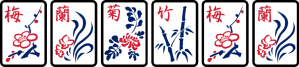
- You can make one set of 2 or more flowers up to the total number of flowers added to the game.
- Flowers are the only tiles where you can make a set larger than 4 tiles.
- All flower tiles are identical, making flowers a suit with only 1 number.
- Jokers cannot be used in a flower set.
Sample Winning Hand with Flowers

- Suits: Flowers & Bams
- Sets: 5-Flowers, Pair, Quad, Triple
- Sequence: 6, 8, 10 (Evens)
Wind Suit:
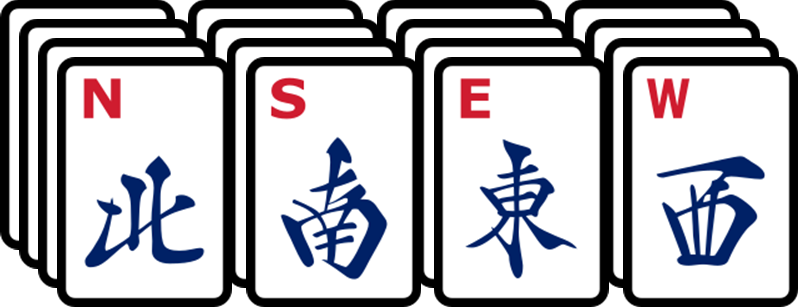
- You can make a sequence of winds using 4 sets, one of each wind.
- Sets of wind tiles can be combined in the same hand with a flower set.
- Sets of wind tiles cannot be combined with sets of number tiles in the same hand.
Sample Winning Hand with Winds

- Suits: Winds & Flowers
- Sets: Pair, Quad, Triple, Pair, Triple
- Sequence: N, E, W, S
Using Special Action Tiles
There are two special types of tiles that are usually included in Mahjong sets that allow you to take special actions in the game: Joker Tiles and Blank Tiles. These tiles are not part of a suit, instead they are used to replace or exchange for other tiles to help you complete a winning Mahjong hand. You can add one or both of these types of tiles to the game, or you can play without them. The more joker and blank tiles you add, the easier it is for players to make a winning hand, so adjust the amount used according to the skill and experience of the players, or the style of game you want to play.
Jokers:

- A joker tile can take the place of a number tile or a wind tile in a Triple or Quad set.
- Jokers cannot take the place of a flower tile or a tile in a Pair set.
- A Triple or Quad set can contain all Jokers replacing a set in a sequence.
- A discarded joker can’t be picked up by another player.

Sample Winning Hands with Jokers



Blanks:
- You can’t use blank tiles in a winning Mahjong hand.
- You must either discard blank tiles or perform a Blank Swap to remove blanks from your hand.
- A discarded blank can’t be picked up by another player.
Shuffle and Deal
- Four players sit at a square table.
- If using racks, place one in front of each player with the slanted side facing the player.
- Decide which tiles you will use in the game, placing them face down on the table. The number tiles with dragons are required, while the other types are optional:
- Winds: If using, include all 16 tiles.
- Flowers: If using, include 6 to 8 tiles.
- Jokers: If using, include 4 to 8.
- Blanks: If using, include up to 4.
- All players shuffle the tiles by mixing them around face down, turning over any tiles that accidentally flip up.
- Each player randomly selects 13 tiles, placing them in a row facing themselves, hidden from the other players. These 13 tiles are the player’s hand. *
- Pick a starting player for the round. Following Mahjong tradition, that player is called the “East” player for the round.
- Players take a minute or two to arrange the tiles in their hands.
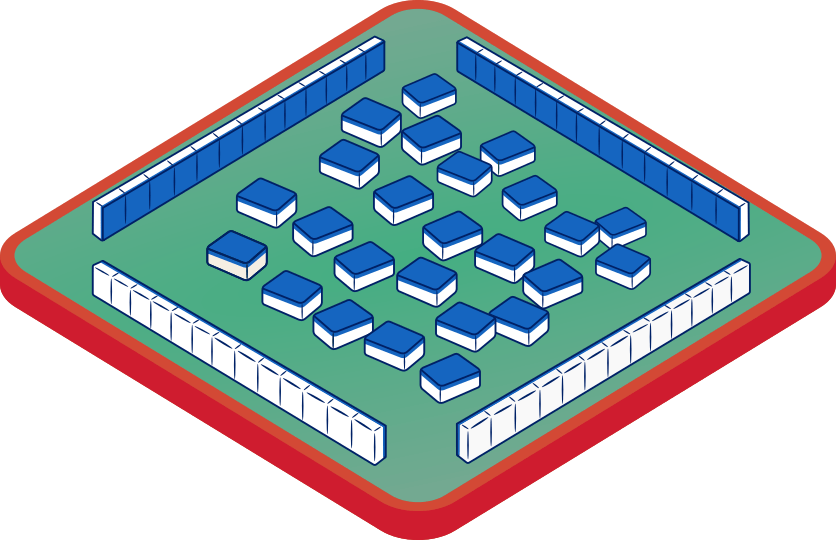
* If you prefer the traditional method of building walls and dealing, you are welcome to do so, though the method is not described here. The number of tiles in the walls will depend on how many tiles you include in the game.
Round Start
Pass 3 Tiles
- To start a round, each player passes three tiles from their hand to the player on their left.
- The tiles are kept face down until all players have finished passing.
- Once all the tiles have been passed, players put the tiles they received in their hands.
The First Turn
- First, the East player draws one random face-down tile and places it in their hand.
- Then East discards one tile from their hand. The drawn tile can be the tile that East discards.
- After the discard, either any player can “call” the tile discarded by East, or the player to the right of East draws a face-down tile. See Taking a Turn below for the rules.
Taking a Turn
Step 1 (Mandatory) – Take One Tile:
Draw a random face-down tile or pick up the last discarded tile.
Drawing a Face-Down Tile
If no player picks up the last discarded tile, then the next player to the right draws a random face-down tile. Out of courtesy, you should wait a few seconds to see if anyone wants to call the last discarded tile before drawing a face-down tile.
Picking Up a Discarded Tile (“Calling”)
Once a tile is discarded, any player can claim that tile by saying “Call” out loud then picking up the discarded tile. You can call any tile except a blank or a joker, in these two circumstances:
- You can make a set using at least 2 matching tiles and/or jokers from your hand.
- Place the called tile and the additional matching tiles from your hand face up in front of your hand, or on the flat part of your rack for all players to see.
- This set is now an “exposed set” and cannot be added to or subtracted from for the rest of the game.
- Exposed sets are still part of your hand.
- The discarded tile is the last tile you need to form a winning Mahjong hand.
- When this happens, say “Mahjong” out loud and show all of your tiles to the other players.
- If you have a valid Mahjong hand, the round ends.
If more than one player calls the same discarded tile, the priority for who gets the tile is:
- A player calling Mahjong
- The player calling for the set with the most number of tiles.
- The player in turn order closest to the discarding player.
Step 2 (Optional) – Swap Tiles:
Perform a Joker Swap or a Blank Swap
Joker Swap
A Joker Swap allows you to exchange a joker tile with a number tile or a wind tile in one of two ways:
- Swap a matching tile from your hand with a joker in any player’s exposed set.
- Swap a joker from your hand with any tile in any player’s exposed set except for flower tiles.

You can Joker Swap with an exposed set from another player or from your own exposed sets. When swapping with your own tiles, announce it to the rest of the players. You can make as many Joker Swaps on your turn as you like.
Blank Swap
A Blank Swap allows you to exchange a blank tile from your hand with any discarded tile that is face up on the table except a joker or another blank. You can make as many Blank Swaps on your turn as you like, using these steps:
- Place a blank tile from your hand face up on the table next to a previously discarded tile you want to pick up.
- Say “Blank Swap” and say which tile you are picking up.
- Pick up the tile and put it in your hand.
Step 3 (Optional) – Declare Mahjong:
If you have a winning hand, declare Mahjong to win the round.
After you have drawn a tile, and after you have made any Joker Swaps and/or Blank Swaps, you may have a winning Mahjong hand.
- If your hand meets the Three S Rules, you can declare Mahjong.
- You do not have to declare Mahjong if you want to try to build a higher scoring hand.
- Once you declare Mahjong, turn all your hand tiles face up for the other players to see.
- If you have a valid Mahjong hand, the round ends and you win!
Step 4 (Mandatory) – Discard One Tile:
Place any tile from your hand face up on the table, saying the name of that tile out loud.
If you don’t declare Mahjong, discard one tile face up and say the name of that tile out loud. The discarded tile can be placed anywhere on the table between the other players. After discarding a tile, either a player will call the tile, or the next player to the right will draw a face-down tile to start their turn.
Round End
The round ends once a player completes a Mahjong hand, or the final face-down tile is drawn then one final tile is discarded. The final discarded tile can be called for Mahjong. The player sitting to the right of the East player becomes the new East for the next round. If the round ends without a player making a winning Mahjong hand, no points are scored. This is called a Wall Game. A full game can end after a set number of rounds (4 is standard) or a set length of time.
Scoring
A winning Mahjong hand earns one point for each scoring factor from the list below that applies to the hand at the time Mahjong is declared:
| Mahjong | The hand is a valid Mahjong hand |
| Suit Flush | Only one suit is used |
| Full Sequence | Use all the numbers in a sequence: Evens (02468), Odds (13579), or Threes (0369) |
| Big Sets | The hand is made of 6 or 7 sets |
| 7 Pairs | The hand is made of 7 pair sets. |
| Bouquet | A flower set of more than 4 tiles is used |
| Self Draw | The last tile drawn was a face-down tile |
| Concealed | The hand has no exposed sets. |
| Jokerless | No jokers used in the winning hand |
| Sunrise | Mahjong made on player’s first turn |
| Sunset | Mahjong with final possible face-down tile or final possible discarded tile |
Scoring Example

This player made no exposure sets during and called a discarded tile for Mahjong.
+ 1 Mahjong +1 Concealed +1 Jokerless = 3 POINTS
Minimum Hand Value (Optional)
Experienced players can set a minimum hand value for a winning hand, increasing the difficulty and complexity. A minimum of 2 or 3 points for a winning hand is suggested for advanced players.
Payouts to the Winner
At the end of a round with a successful Mahjong hand, the value of the hand is paid to the winner by the other players:
- One point is worth one scoring token or one coin of whichever type you are using: pennies, nickels, dimes, or quarters.
- Each losing player pays the winning player the hand value.
- If a player discarded the last tile called for Mahjong, that player pays the winner double the hand value.
Payout Example
In the scoring example above, the hand value was 3 points. Here’s how the payouts would work if the group is playing for one quarter per point:
- The player who discarded the tile that the winning player called for Mahjong pays the winner 6 quarters ($1.50) which is twice the hand value.
- The other two players pay 3 quarters ($0.75) each to the winner.
- The total paid to the winning player is 12 quarters ($3.00).
More Than One Mahjong
Sometimes the same discarded tile can complete a Mahjong hand for more than one player at the same time. When this happens, the players who did not have a winning hand pay the players who did have winning hands. The player who discards a tile that gives multiple players Mahjong only pays the hand value to each winning player, not double the hand value.
Mistakes Happen
Flex Mahjong is meant to be fast and fun, not fiddly and fussy. If someone makes a mistake, the official rule of Flex Mahjong is simple:
Point out the mistake, fix it, keep playing.
Examples of Common Mistakes
- If a player declares Mahjong but the hand isn’t valid, the player puts all the tiles they hadn’t exposed back in their hand and play continues.
- If a player has too many tiles at the start of their turn, they discard a tile without drawing a tile.
- If a player calls for a tile, but the exposure is not valid, such as exposing a pair set, then they put the called tile back on the table and place the remaining exposed tiles back in their hand.
- If a player exposes 3 sets with 3 different suits, that hand will not be legal so players can either let the player know and they can take the move back, or just say nothing and if the player eventually calls Mahjong it will be invalid.
No “Dead Hands”
The official National Mah Jongg League rules list a number of mistakes that would allow your opponents to call your hand “dead”, forcing you to stop playing in the round, including simple mistakes like misnaming a discarded tile, drawing out of turn, or picking from the wrong end of the wall. In order to keep American Flex Mahjong streamlined and fun, there are no rules for calling hands dead and punishing players for mistakes. Players can self govern their games however they see fit.
Other Player Counts
Two Players
Standard Flex Mahjong
Play with the same rules above, except have the two players sit across from each other. After shuffling, set aside roughly half of the tiles not to be used in the game.
Siamese Mah Jongg®
Another way to play with two players is by using the rules from the excellent game as Siamese Mah Jongg®, where you build two hands and try to Mahjong with each one. To play Flex Mahjong with Siamese rules, use the game play rules of Siamese with the Three S Rules and scoring of Flex Mahjong. Check out the Siamese Mah Jongg® official website at www.SiameseMahJongg.com where you can find the rules, equipment, and much more.
Three Players
Play with the same rules above, except after shuffling remove 30 tiles setting them aside not to be used in the game.
More than Four Players
If you have more than 4 players, the best thing to do is to break up into 2 or more groups. If you have 5 or 6 players, you can play a single game and have players rotate in and out of the game. When a round ends, the East player sits out and the next player rotates in.
Flextra House Rules
The soul of the game is Flexibility and Freedom, so house rules are strongly encouraged! Once you have some games under your belt, you can add some Flextra House Rules to your game, which add even more complexity and creativity. Click the link below for a page full of Flextras.

Contact
Do you have questions about how to play?
Do you have ideas for interesting house rules?
Do you have any feedback to make the game better?
Send me an email!
 Flex Mahjong